
Concrete leveling / Foam injection
Lift the slab. Fill the void.
High-density polyurethane foam can restore support and improve elevations through small injection ports—when the slab and underlying condition make it the right repair candidate.
Request a site evaluation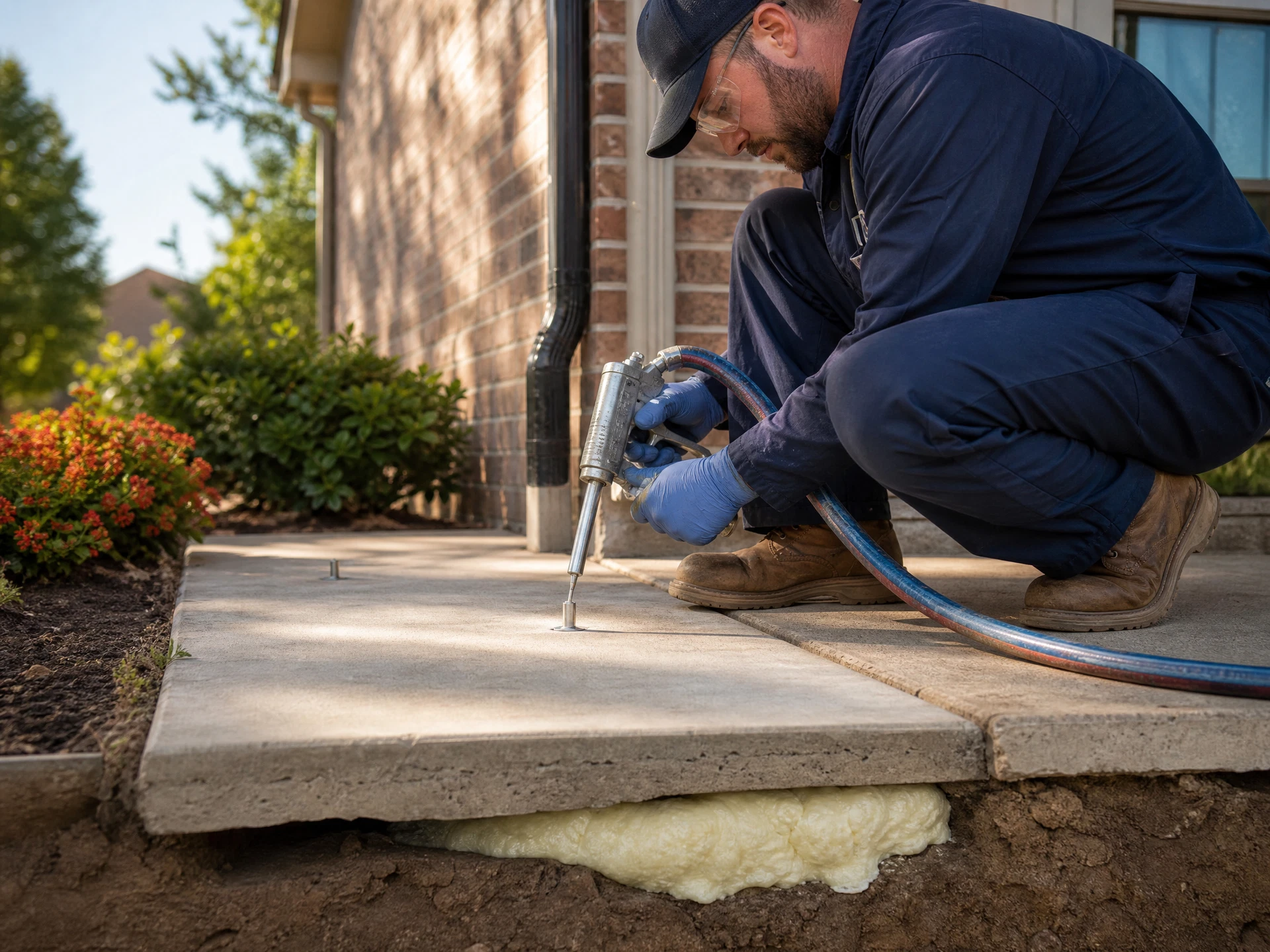
Above grade / below grade
Small-port process
Controlled lift with limited disruption.
Foam leveling can be faster and less invasive than removal and replacement for appropriate slabs. Candidacy depends on concrete integrity, drainage, voids, and the target elevation.
- 01
Map the slab
Evaluate elevations, joints, cracking, adjacent structures, drainage, and likely void areas.
- 02
Create injection ports
Small, strategically placed holes provide controlled access beneath the concrete.
- 03
Inject + monitor
Expanding polyurethane fills voids and can raise the slab in measured increments.
- 04
Seal + review
Ports are patched and the completed elevation, transitions, and surrounding conditions are reviewed.
Potential candidates
Where foam leveling may fit.
Sidewalk panels
Patios
Drive approaches
Garage or floor slabs
Steps and landings
Selected commercial flatwork
When another path may be better
Not every slab should be lifted.
Replacement, drainage correction, structural repair, or another approach may be more appropriate when the concrete is extensively broken, reinforcement is compromised, erosion is ongoing, grades cannot be corrected safely, or the slab is part of a larger structural problem.
Severely fragmented concrete
Unresolved washout or water path
Insufficient room to achieve safe slope
Structural concrete distress
Adjacent system or utility conflict
Below the slab
Settlement starts in the support zone.
Voids can develop through consolidation, washout, poorly compacted fill, or changing moisture. A repair plan should consider how the void formed—not only the elevation visible above it.
Port
Expanding foam
Recovered support
Uneven concrete?